Polarization-dependent PL
Why. A quantum dot’s bright exciton is split into two lines polarized at right angles — the fine-structure splitting (FSS). It decides whether the dot can emit entangled photon pairs, so it is measured on every candidate dot. The splitting is usually smaller than the linewidth: it shows only as a tiny swing of the line’s centre while the analysed polarization turns, read over a whole sweep of spectra. That is one plate move, one position check and one exposure per angle, ninety angles per dot — the work this experiment does unattended.
What it measures. For each dot, one spectrum per angle of a half-wave plate in front of a fixed polarizer:
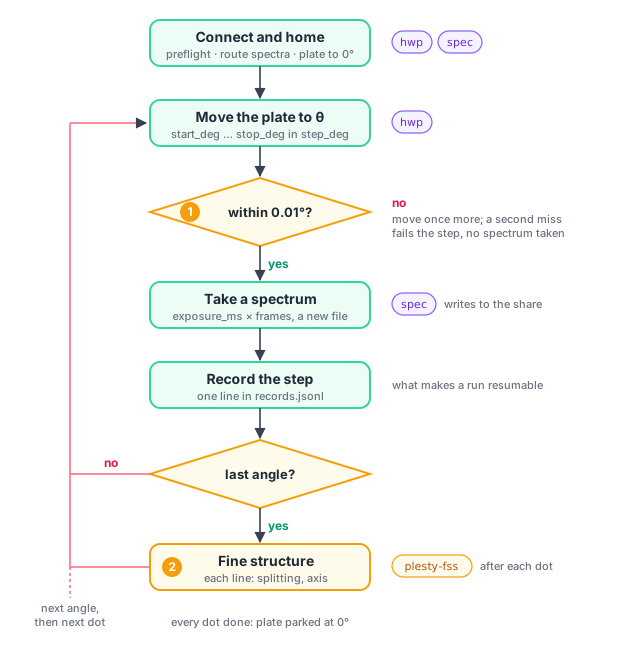
What it analyzes. After a dot’s last angle, the FineStructure analyzer of
plesty-fss fits every line in every spectrum, then a sine to each line’s centre
against the angle: its peak-to-peak is the FSS, its phase the polarization
axis — see Analysis.
uv sync
uv run python -m plesty.pol_pl --dry-run                       # the plan, no devices
uv run python -m plesty.pol_pl --config config/default.yaml    # run
Page |
Shows |
|---|---|
the devices, the plan, what to set and configure |
|
start it, the demo, drive and watch a run, what it writes |
|
each numbered box above, what it reports, how to read it |