Setup
The devices
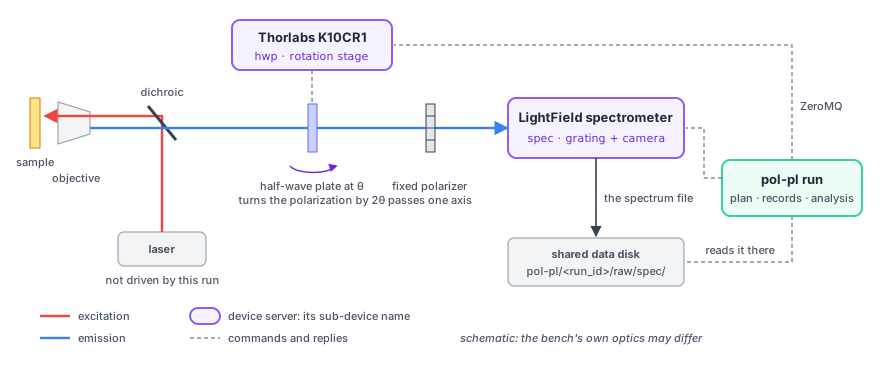
Sub-device |
Instrument |
Package |
Bench |
|---|---|---|---|
|
Thorlabs K10CR1 rotation stage carrying the half-wave plate |
|
|
|
Princeton Instruments LightField spectrometer |
|
|
setup.yaml names both, each on the bench it runs on (host_name); another
bench is shown commented out, as an example. The servers are installed and run
from their own repositories, on the computers the hardware is attached to.
Spectra never cross the network: the spectrometer writes them to the shared
data disk and only their paths travel.
The plan
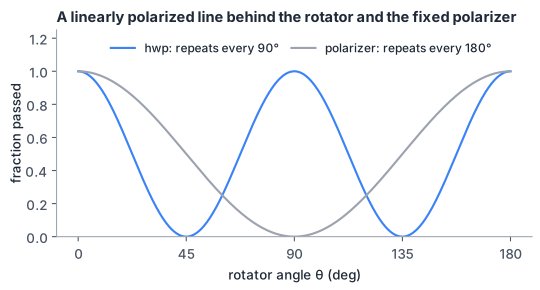
One step is one plate angle of one dot. The dots run in the order of qds,
each through every angle from hwp.start_deg to hwp.stop_deg in step_deg,
then one analysis step. The plate turns the polarization by twice its angle, so
the pattern repeats every 90°; the default 0–178° in 2° steps covers it twice.
--dry-run prints the plan without touching a device.
What to set before a run
.env.example→.env:LOCAL_DATA, where this machine sees the shared data disk, and the address, token and data path of any other benchsetup.yamlnames. A bench writes this file when it installs the module.qds: each dot’sidand stage coordinates. The run does not move the sample — each dot must be on the spectrometer when its sweep starts.analysis.fit_options: the lines to follow, by position (peaks) or by how far they stand above their surroundings (prominence).
Configuration
config/default.yaml, frozen into each run’s plan: a resumed run refuses a
changed one. Sections left out take the module defaults.
Group |
Acts on |
Keys |
|---|---|---|
— |
the whole run |
|
|
Move the plate to θ |
|
|
Take a spectrum |
|
|
② |
|
--prominence COUNTS replaces analysis.fit_options.prominence for one run;
the run saves the value it used. --manifest prints every key with its type,
unit, bounds and meaning, from SCHEMA in plesty/pol_pl/__main__.py. The
time windows and the 0.01° tolerance of ① are properties of the hardware, fixed
in the packaged plesty/pol_pl/config.yaml.
# Measurement configuration — tuning values only, never credentials
# (endpoints and the shared disk live in `.env`, see `.env.example`).
# The config is frozen into each run's plan: a resumed run refuses a
# changed configuration. Sections left out take the module defaults.

sample: sample-000

# Dots measured one after another; the steps assume each dot is already on the
# spectrometer. Coordinates are recorded with every spectrum.
qds:
  - {id: QD-01, x_um: 0.0, y_um: 0.0}

# Half-wave plate in front of the fixed polarizer. Its polarization pattern
# repeats every 90° of plate angle; 0–178° in 2° steps covers two periods.
hwp:
  start_deg: 0.0
  stop_deg: 178.0
  step_deg: 2.0

spectra:
  exposure_ms: 1000
  frames: 1
  filename_prefix: pol_pl
  # How long a written spectrum may take to appear on this machine's mount.
  file_visibility_timeout_s: 60

# Pause after the plate has settled, before each exposure.
step_settle_s: 0.0

# Fine-structure analysis after each dot's sweep (plesty-fss FineStructure).
analysis:
  enabled: true
  rotator: hwp
  # Passed to plesty.lib.analyzer.SpectrumFit, e.g. peaks: [775.1, 776.4],
  # window: 0.1, center_tolerance: 0.05. Empty: lines are found automatically.
  fit_options: {}