Architecture
This is the living architecture document for plesty-lib. It records the
module structure, the public contracts between the layers, and the reasoning
behind the design choices — so that future changes are made with the
design, or change this document first. Detailed usage of each part lives in
the guide pages (Device, Experiment,
Data & Metadata Schemas); this page stays at the level of
boundaries and decisions.
High-level module view
Everything ships under the plesty.lib namespace package:
Package |
Role |
|---|---|
|
Foundation utilities: logging setup, error handling, the process-wide |
|
Data containers and persistence: |
|
Transport backends (traffic managers): Serial, VISA, USB utilities, raw TCP/IP, and Thorlabs APT (binary framing, |
|
Protocol translation: the |
|
The core device tier: |
|
Remote access: the ZMQ-based device TCP/IP server and client, plus the per-device |
|
Data reduction: the synchronous |
|
Reproducible orchestration: the async |
|
Live views: the |
|
GUI framework: the |
|
Stand-ins for hardware: |
|
Shipped test helpers and the standard contract pipelines that hub modules import: |
Layering
The library is layered bottom-up; each tier may depend on the tiers below it, never above:
Tier |
Packages |
May import |
|---|---|---|
5 — presentation |
|
|
4 — orchestration |
|
everything below ( |
3 — remote access |
|
|
2 — device core |
|
|
1 — protocol & transport |
|
device metadata dataclasses ( |
0 — foundation |
|
standard library (+ |
Two edges deserve a note. device and service are a deliberate pair
rather than a strict layer: the TCP/IP server wraps a device (via the async
wrapper), while CompositeDevice consumes TCP/IP clients — the packages
reference each other, and this coupling is contained to
composite_device.py on the device side. Similarly, solver sits beside
device rather than below it: solvers depend only on the metadata
dataclasses (ConfigParameter, FuncMeta) that the device systems define,
not on the device model itself.
The device tier itself is split into six layers above the vendor hardware — traffic manager, command solver, synchronized device, async wrapper, TCP/IP server, TCP/IP client — of which only the bottom two are written per device:
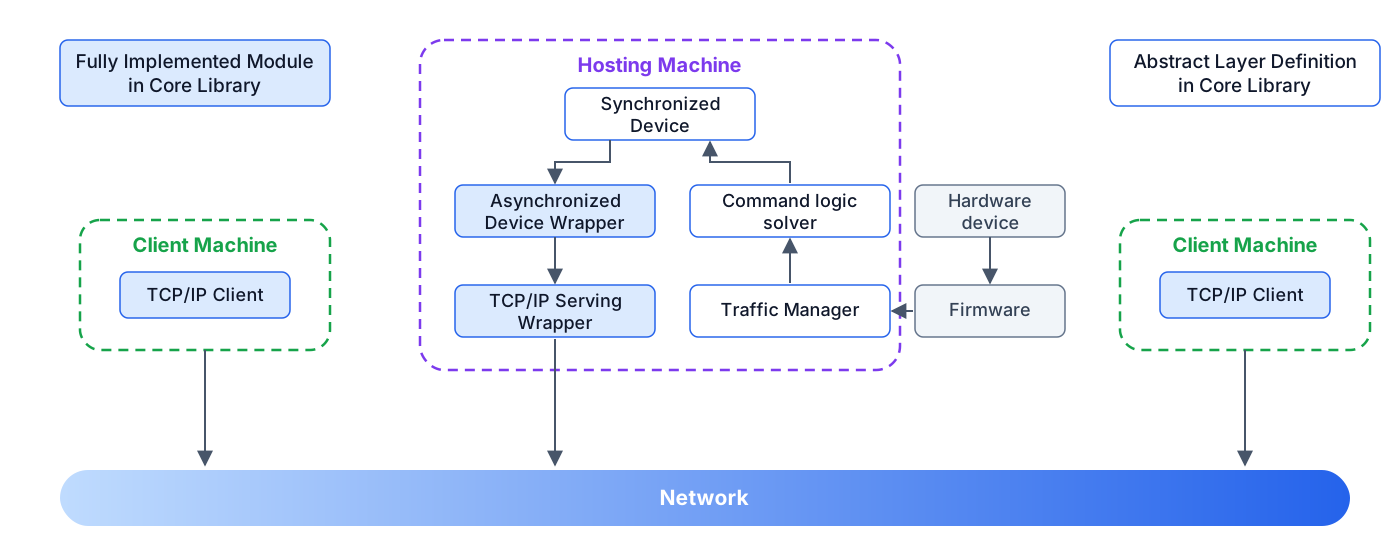
The landing page walks through this figure and the structure of
the synchronized device (imgs/device_standard.svg).
Interface contracts
The contracts below are the load-bearing public API. Each entry says what the contract guarantees and where the detailed guide lives — the guides, not this page, document parameters and usage.
BaseDeviceSyncModel + system mixins —
plesty.lib.device.base_device_sync. Every device inherits the abstract
model, which composes three orthogonal systems: ConfigSystem (schema-declared,
validated parameters — Parameter system),
FunctionSystem (schema-registered operations plus @expose_to_api
methods — Function system), and TelemetrySystem
(cheap status() snapshots and hookable events — see
Data & Metadata Schemas). Subclasses implement
connect/disconnect/_write_/_query_/check_errors/check_operatability;
write/query validate, log, parse, cache, and emit telemetry around them.
The context manager (with device:) owns the resource-lock lifecycle. See
Base device.
doc_model() / DeviceDocModel — plesty.lib.device.doc. The single,
render-agnostic source of truth for a device’s user-facing documentation:
parameters grouped by config group, functions (schema-registered and
custom operations unified as FuncDoc), and standard_methods (the common
device API). Renderers — the SDK docs generator, summary(), the server
describe endpoint — consume it instead of re-deriving metadata. See
Base device.
Solver contracts — plesty.lib.solver. CmdSolver builds write/query
command strings from a ConfigParameter; OpSolver.solve_request resolves
an operation request dict into a response dict. SCPISolver.solve_func
additionally dispatches any operation whose whole exchange is one SCPI
command and a scalar response, driven by a FuncMeta built from the
"command" field of the operation schema — no hand-written dispatch for
simple operations. See Command solver.
CompositeDevice remote-call contract —
plesty.lib.device.composite_device. Groups local devices and remote
TCP/IP clients behind one object. call(dev, func, ...) guarantees that a
request timeout on a remote sub-device triggers a client rebuild (flushing
the stale ZMQ reply) and a bounded retry before the final TimeoutError
propagates; reconnect(dev) and connect_client() back it. See
Composite device.
Experiment / Plan / Journal lifecycle — plesty.lib.experiment.
build_plan() yields a frozen, content-hashed Plan of Steps; run()
validates every Step.op against the experiment’s own public methods before
any device is touched, journals each step to an append-only JSONL log, and
run(resume=<run_id>) skips journaled-complete steps while refusing a plan
whose hash changed. teardown() is always awaited. See
Experiment framework.
Analyzer transform contract — plesty.lib.analyzer. Subclasses
declare input_schema/output_schema (device-schema dtype vocabulary) and
implement one synchronous analyze(); the validating __call__ checks
inputs, fills output metadata from the schema, and stamps every array/table
result with a provenance dict (analyzer class, package version,
constructor params — calibration included). Analyzers consume data-layer
objects and never import device drivers. See
Analyzer framework.
Monitor live-view contract — plesty.lib.monitor. Subclasses declare
input_schema (device-schema dtype vocabulary) and implement traces()
(what is drawn, once) plus update() (what to draw per frame); submit()
validates the frame, checks the returned trace keys, and fans out to every
attached Renderer. Sources expose one non-blocking poll(), so the
framework owns no thread and no clock. Monitors are strictly read-only —
RunSource follows the result documents an experiment already committed,
which is why watching cannot disturb measuring. See
Monitor framework.
Shell and panels — plesty.lib.ui. Panel is the dockable unit
(anything worth a sub-window, not only a view); Shell is the home window
that docks, floats, tabs, and persists their arrangement, ticking each panel
on one timer. Theme reads the packaged palette and stylesheet assets, so no
colour or markup is written in Python. The Qt backend lives behind the gui
extra and nothing else in the library imports it. See
Shell framework.
Result persistence — plesty.lib.data.io. save_result writes the
blob first (atomically) and the typed ResultDocument JSON last — the JSON
file is the commit record. load_document reads metadata without blob I/O;
convert_to_hdf5 optionally packs documents into one archive. See
Data & Metadata Schemas.
Contract test pipelines — plesty.lib.test. DevicePipeline (eight
mock gates, SDK gate d1), ExperimentPipeline (five hardware-free gates,
SDK gate E1), and AnalyzerPipeline (five gates on schema-generated
synthetic inputs, groundwork for SDK gate a1) define what every hub module
must prove: schema integrity, mock round-trips, lifecycle (device tier);
deterministic plans, resolvable ops, serializability (experiment tier);
analyze-signature match, round-trip validation, provenance (analyzer tier).
A device module exposes one pytest function calling run_mock_pipeline();
experiment and analyzer modules expose one function per gate. What a mock
cannot reach — the command-format contract, transport pathologies, resource
contention — belongs to FieldTestPipeline on the instrument,
client_field_test over the wire, and field_test_concurrency for devices
sharing a host. See Test helpers.
Design Decisions
Decisions are recorded with the alternative that lost and why. Revisit a decision by adding a dated amendment, not by silently diverging.
System mixins instead of a deep inheritance chain
BaseDeviceSyncModel composes ConfigSystem, FunctionSystem, and
TelemetrySystem as cooperating mixins with explicitly chained __init__s,
rather than stacking them in an inheritance ladder
(ConfigurableDevice → FunctionDevice → …). The systems are orthogonal
concerns, so a ladder would impose an arbitrary order and force every
subclass to take all rungs; with mixins, each system is independently
testable (the test helpers exercise ConfigSystem alone) and adding
TelemetrySystem in this release required no change to existing device
subclasses. The cost is a wider attribute surface on one class and the risk
of name collisions — real enough that the system solver attributes were
renamed to _cmd_solver/_op_solver after a clash with user-defined
device methods (lib#1).
A structured doc_model() instead of generating docs directly
Device documentation used to be whatever summary() rendered. This release
introduces DeviceDocModel — data, not markup — and keeps rendering out of
the library. The alternative (each renderer walking the parameter and
function registries itself, or the device emitting Markdown) had already
produced drift: the server describe endpoint, summary(), and the SDK
docs generator each re-derived metadata slightly differently. One extraction
path also let framework plumbing be separated from device operations
(standard_methods vs functions) once, for all renderers. Tradeoff: an
extra indirection, and summary() has not yet been migrated onto the model,
so two extraction paths coexist until it is.
Resource lock acquired on connect, not on construction
ResourceRegistry.acquire() runs in __enter__ (released in __exit__ and
on a failed connect), no longer in __init__. Locking at construction made
instantiating a device a side effect — documentation generators, offline
tooling, and tests could not create a device object without claiming the
hardware key, and a crashed process could leave a stale claim (now also
mitigated: a dead weak reference is reclaimed). The tradeoff is honest: the
conflict between two instances of the same device id now surfaces later, at
connect time, and code that calls connect() directly instead of using the
context manager bypasses the lock entirely — the guarantee is tied to the
with lifecycle.
Resilient CompositeDevice remote calls instead of failing fast
A ZMQ REQ/REP client that times out leaves a stale reply in the socket; the
naive client was permanently broken afterwards
(lib#10).
CompositeDevice.call therefore rebuilds the client and retries on
TimeoutError (lib#15)
rather than propagating immediately: in a multi-hour scan, a transient
network hiccup on one sub-device should not abort the whole run, and before
this every hub composite re-implemented its own ad-hoc retry loop. Failing
fast remains available — retries are bounded and the final timeout
propagates. The real tradeoff is that a retried call is not guaranteed
idempotent: if the server received the request but the reply timed out, the
operation may execute twice. Callers with non-idempotent operations should
pass retries=1.
Consumer-owned telemetry hooks instead of a background telemetry service
TelemetrySystem defines the schema (DeviceStatus, TelemetryEvent)
and a synchronous hook mechanism — no polling threads, no transports, no
service process (lib#4).
A built-in telemetry daemon was rejected because it would impose lifecycle,
threading, and transport choices on every device, and background polling
can disturb timing-sensitive instrument I/O. Instead the cost model is
strictly pay-per-use: with no hook registered, no event object is even
constructed. The tradeoff: consumers who want periodic monitoring must run
their own loop, and a slow hook slows the device call that emits it
(failing hooks are logged and skipped, slow ones are the consumer’s
problem).
JSONL journal + content-hashed plan instead of a database
Experiment state is an append-only JSONL journal next to a frozen
plan.json (lib#3).
A database would give queries and concurrent writers, but a lab experiment
has one writer, and a database server (or even SQLite file locking on
network shares) is exactly the kind of dependency that fails at 2 a.m. in
an instrument room. Append-only JSONL is crash-safe by construction (a torn
final line is detectable and discardable), diffable, and greppable; the
SHA-256 content hash of the plan makes “the schedule silently changed”
a refusable error on resume rather than a corrupted run. Replay cost is
linear in journal length — acceptable at measurement scale, and a real
limit if runs ever reach millions of steps.
Raw blob + JSON metadata, HDF5 as optional export — not mandatory HDF5
save_result keeps each result in its original raw format (.npy, native
image bytes, or values inlined in JSON) described by a typed
ResultDocument, with convert_to_hdf5 as an opt-in packing step. An
HDF5-first store was rejected: it would make h5py a hard dependency of
every device module, re-encode camera output that is already a valid PNG,
and concentrate crash risk in one archive file — whereas the two-file
blob-then-document protocol is atomic per result. The tradeoff is many
small files per run instead of one archive, and consumers who want HDF5
must run the conversion step.
Allowed dependencies
The sanctioned third-party runtime dependencies (from
pyproject.toml):
Dependency |
Why it is allowed |
|---|---|
|
The array baseline of scientific Python; backs |
|
Serial-port transport for the serial traffic manager. |
|
VISA instrument transport (GPIB/USB-TMC/…); the de-facto standard for SCPI instruments. |
|
Raw USB access and device-reset utilities in the traffic layer. |
|
Messaging for the device TCP/IP server/client; battle-tested REQ/REP with timeouts. |
pytest and plesty-sdk are development-group dependencies only and must
never become runtime requirements.
Policy: a new runtime library may be introduced only if it is actively
maintained — visible upstream activity (release or commits) within the last
two years — and it must be added to the table above in the same merge
request. Every dependency also passes pip-audit on each push (plesty check gate 10), so a library that stops receiving security fixes will be
flagged and must be replaced or vendored.
Optional dependencies
Every module in the hub depends on plesty.lib, so a package added to the
table above is installed on every lab machine running Plesty. A library that
only one feature needs — or that is heavy, compiled, or platform-specific —
is therefore declared as an extra in [project.optional-dependencies]
instead, imported lazily inside the function that needs it, and raises an
ImportError naming the extra when it is missing. The base install stays
small and the dependency is still visible to resolvers, lockfiles, and
audits.
Extra |
Adds |
Needed by |
|---|---|---|
|
|
|
The packages behind these extras are mirrored in the optional dependency
group, which [tool.uv] default-groups installs by default. CI runs a bare
uv sync --frozen, which installs no extras — without the mirror, every
optional code path would go untested there.
Technical debt
Technical debt lives in the issue tracker, not in this document: every debt item is filed
as a GitLab issue labeled
type::debt
— per the
governance DoD,
permanent architectural debt is filed before the shortcut lands. One standing caveat
matters when reading this document: the DevicePipeline gate design reaches main for
the first time with v0.3.0 after an earlier revert — treat its gate list as provisional
until the redesign pass
(lib#16).